For a nostalgic journey through time, visit the Wonders of Wynyard. Home to a world-class Veteran Car Collection, including the equal oldest Ford in the world – the collection has been lovingly restored and is an outstanding showcase of Australian motoring history.
Children under 15 enter FREE (when accompanied by paying adult). Group of 15 or more: $9.50pp.
Why visit us?
Check out what recent visitors said when visiting...
Posted on
Tyler Lunn
Trustindex verifies that the original source of the review is Google.
I went here with my girlfriend and fell absolutely in love with the place, Chris was our guide and was so passionate and talkative about the engineering and history of these cars! Would definitely pop in and say hello again.😁 🚗
Posted on
Mitch Taylor (PremiereDirector)
Trustindex verifies that the original source of the review is Google.
I toured Tasmania in November 2018. As the owner of a 1925 Ford Model T touring, I simply HAD to check out Francis Ransley's fine collection of veteran Ford vehicles; and of course the other fine veteran cars in the collection. I have to say, this is the first time I have ever shed a tear over a car. Each and every car is still driven, and are all kept in immaculate showroom condition. Each car has a descriptive sign next to each one, telling the story behind each car and it's history. As a passionate fan of Henry Ford, this museum was a must-see for me - this collection is the finest I have ever seen. The staff were very friendly and knowledgeable on local art and culture. Highly recommended!
Posted on
Larinda Hopton
Trustindex verifies that the original source of the review is Google.
We were fortunate to attend the very first “Tipple and Tour” evening event and it was truly marvellous!! Susan and her team hosted an enjoyable and informative evening. The car collection is a must see and to be able to talk with one of the experts was a highlight. A special mention to the very talented string quartet, Hellyers Road and Alchymia Distilleries and the delicious produce from Hill Farm Preserves. The whisky, the nibbles, the music, the cars all made for a very special evening. Thank you WOW for putting all of this together.
Posted on
D N
Trustindex verifies that the original source of the review is Google.
Lovely staff. Well restored cars, good place for bathroom
Posted on
Peter Kelly
Trustindex verifies that the original source of the review is Google.
Hidden gem of antique motoring.
Posted on
T J
Trustindex verifies that the original source of the review is Google.
Must see collection of vintage cars and bikes
Posted on
Lloyd Bell
Trustindex verifies that the original source of the review is Google.
A superb collection of history. And Colin the guide was amazing at telling the story of these old cars. And they have 1 of 2 original Ford model A cars left in existence. Even if you are not a car enthusiast. You will enjoy.
Posted on
AVSECK NIRAULA
Trustindex verifies that the original source of the review is Google.
Nice and quiet place.
Verified by Trustindex
Trustindex verified badge is the Universal Symbol of Trust. Only the greatest companies can get the verified badge who has a review score above 4.5, based on customer reviews over the past 12 months. Read more
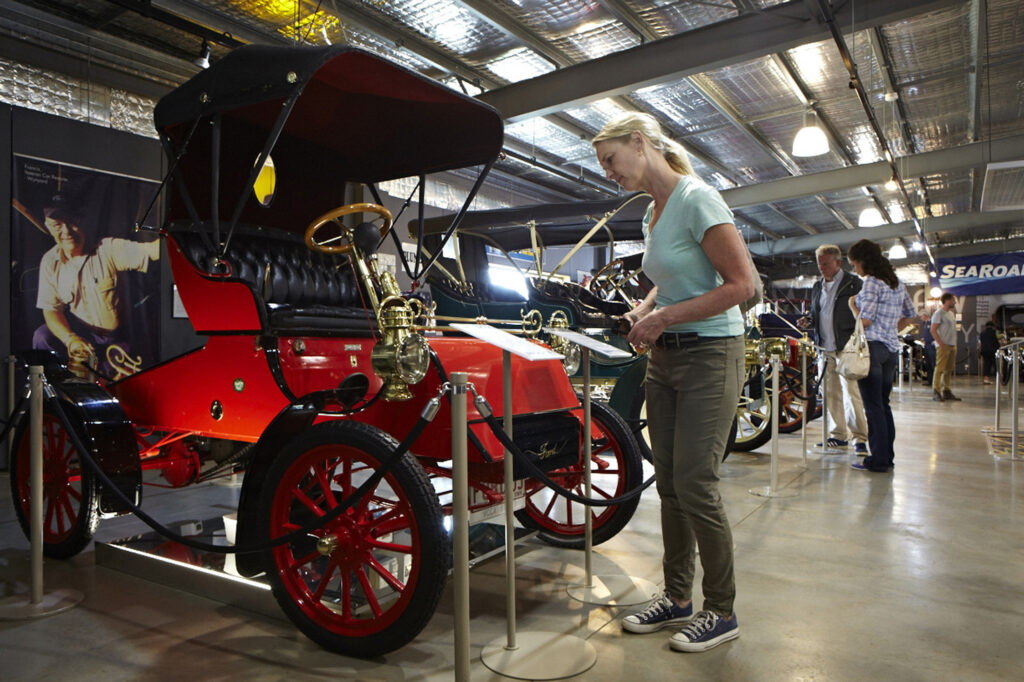
Ford Model A- 1903 “An oldie – but a goodie!”
The Model A was the first car manufactured by Ford after the establishment of the company in 1903. It has a 2 cylinder, horizontally-opposed, 8 horsepower engine with chain drive to the rear wheels. It weighs 1,250 lbs and has a 2 seater body. At first it was simply called The Ford, later to be designated as the Model A.
The World’s equal oldest Ford, with engine no.31, spent the first 86 years of its life just a few miles from where it was built, in Detroit, Michigan. It was delivered to Mr F.E.Avery of Columbus, Ohio, for the purchase price of $600. ‘Extras’ included headlights for $9.60, and the tonneau (extra two seats) for $80.
Records show this car was sold on August 4, 1903, along with car engine no. 30 – and together they are the oldest existing cars built by the Ford Motor Company. The engine cylinders have never been bored and the pistons and rings are the original fitted by Ford in 1903. The wooden framed, aluminium-skinned body is also original, as are the glass side curtains and the exhaust muffler. Ford really made his cars to last back in the day!
In 1989, it was purchased by Mr Francis Ransley, and made the trip halfway across the world to where it resides today, in Wynyard Tasmania. Since obtaining the car from the USA, Francis has completed a full restoration of the magnificent vehicle, however has had to do little other than general maintenance to keep it on the road. In 2003, to celebrate the Ford Motor Company centenary, Ford Australia sponsored Francis and his wife to travel around Australia in the vehicle – travelling to 58 towns and cities where the car was displayed at Ford dealerships and Shows, and clocking over 26,000km in this well-travelled pioneer of motoring history!
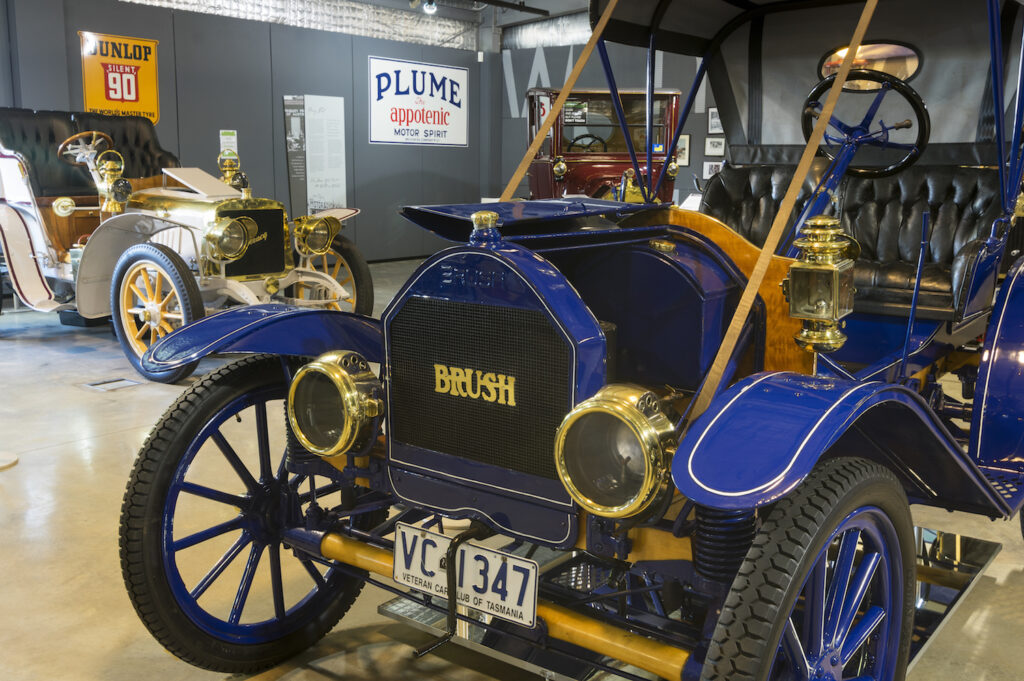
Brush - 1911 - The Everyman's Car
Alanson P. Brush was the brilliant chief engineer for Leland, Falconer and Norton in Detroit, and is credited with the design of the original one-cylinder Cadillac engine. Brush formed his own company in 1906. Despite the Brush Motor Company only manufactured for 6 years, Alanson P. Brush went on to become one of the most respected technical innovators of the motoring industry.
He designed a car called the Brush Runabout, which was unique with its wooden chassis and axles, and was one of the first vehicles to use left hand drive. His reasoning was to enable passengers to alight on the right side directly onto the footpath – thus avoiding the muddy road and traffic.
A distinguishing feature of the engines designed by Brush (who also designed the first Oakland Motor Car, ancestor of Pontiac) was that they ran counter-clockwise instead of the usual clockwise, which, in the days before the invention of the electric starter, was intended to make them safer for a right-handed person to crank-start by hand.
The 1911 Brush has a single cylinder, eight horsepower engine, similar to the Cadillac engine he designed for Leland. The friction clutch and chain drive, revolutionary four wheel independent coil spring suspension with friction shock absorbers, along with the first self-energising brakes fitted to a car, made it an innovative car for its time!
The car was marketed as “Everyman’s Car” – not big, not high powered, but affordable at $485 - the “cost of a good horse and buggy ”. Runabouts, in general, fell out of vogue quickly however - partly due to the lack of protection from the weather.
In 1912, a Brush Runabout was driven by Syd Ferguson and navigated by Australian adventurer Francis Birtles to complete the first east-to-west crossing of the Australian continent from Freemantle to Sydney.
Prior to this, long distance travel in Australia had been limited mainly to the Eastern States, with the cross continent journey (on mainly camel tracks) considered far too arduous. However, the Sydney agents for the American Brush car decided to attempt the first overland crossing as a means of proving the car's stamina.
The Brush's light weight made it ideal for negotiating desert conditions, and despite the challenging weather and landscape, and the need to make a replacement for the big-end bearing and one of the timber chassis rails, the travellers averaged 150 kilometres a day.
After 28 days, their arrival in Sydney on April 15, 1912 was reported by the Sydney Morning Herald: ''It was a quaint sight as the little runabout motor-car began to climb Taverner's Hill - the Brush carried well-known overlander Francis Birtles and the driver Sydney Ferguson - between the two weatherbeaten occupants was a terrier dog, Rex." *
*Click HERE to read the full story on drive.com.au.
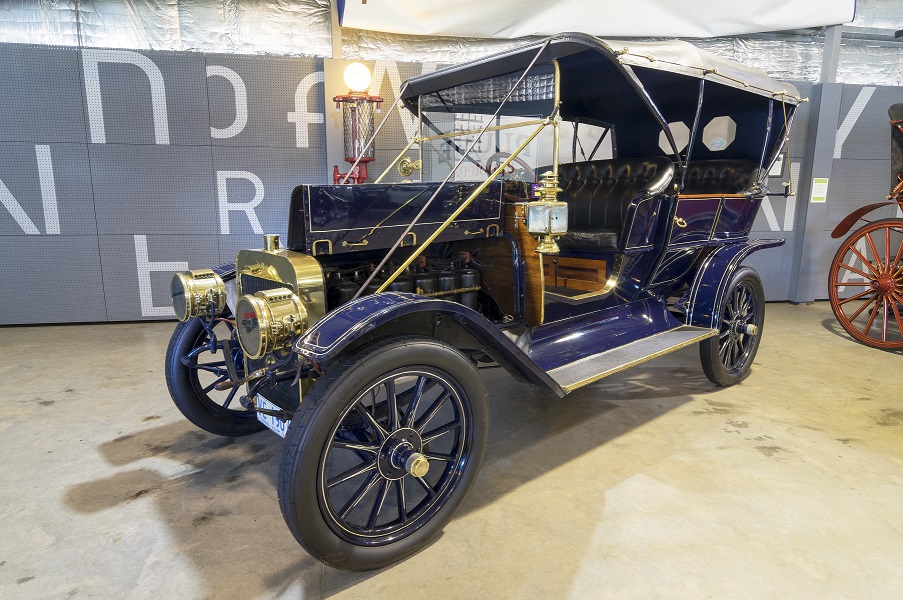
1907 Ford Model K – "One of the Most Important & Rare Ford Automobiles In Existence"*
The Ford Model K, introduced in 1905, was a big, luxurious and elegant car by the standards of the day. It featured a polished brass radiator and headlights as well as the windscreen frame and other accoutrements. It had a large 6 cylinder engine producing 40 horsepower.
It was an expensive car to build – costing between $2500 - $3000. Contrary to the widely held belief that the Model K was Ford Motor Company's “first failure”, the Model K sold well and was profitable, producing over eighty five percent of Ford Motor Company's new car profit in the first year it was offered (1906 Ford Motor Company internal audit records). However the car was a departure from the Henry Fords’ vision to create simple, strong, light, reliable, affordable cars – and was discontinued in 1908 after only around 900 examples being made.
It was well documented that Henry Ford had little time for the Model K – as it was a departure from his vision to create reliable, efficient motor vehicle that was affordable for the masses. He was once quoted as saying "I've got no use for a motor car that has more spark plugs than a cow has teats"'".
Still the Model K holds an important place in Ford history: it is the last Ford to feature a 6-cylinder engine until 1941, and it’s ‘failure’ in the market formed the catalyst for Ford to become a mass producer of cheap cars.
A dispute over production of the Model K led to Alexander Malcomson, one of the founding partners of the Ford Motor Company and a champion of producing luxury cars, leaving the company. This gave Henry Ford the opportunity to become the major shareholder and president of the company in 1906, free to follow his vision to produce Simple, Strong, Light, Reliable and Affordable cars.
With only 900 Model K’s being made and around only 20 still in existence - this is the rarest and most valuable car in Francis Ransley’s collection.
*A quote from RM Sotheby’s (formerly RM Auctions) - the world's largest auction house for investment-quality automobiles
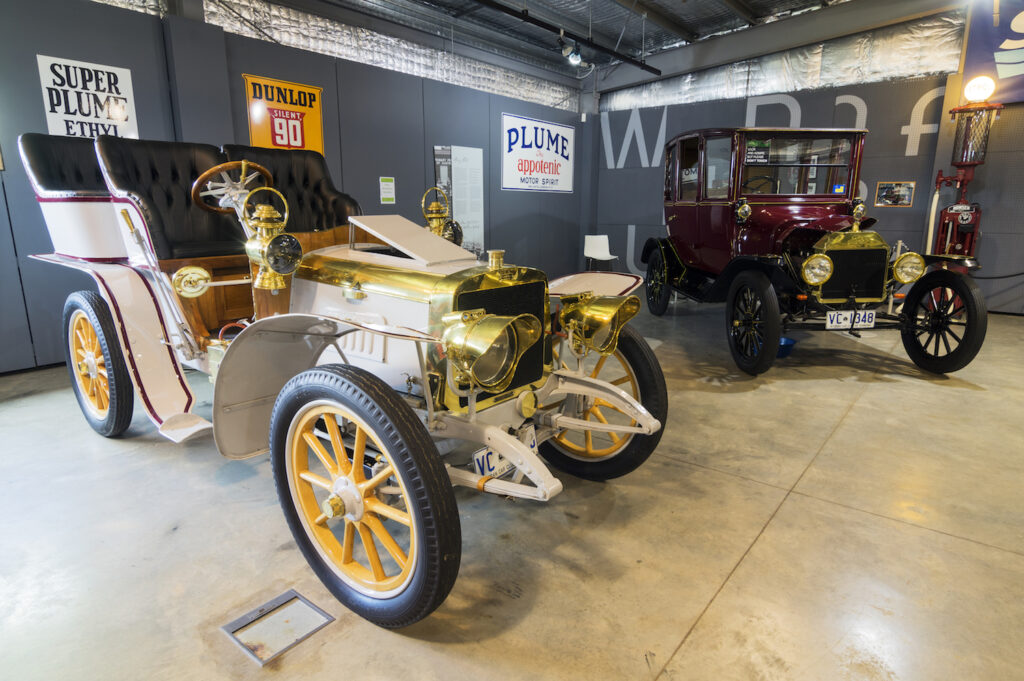
Darracq – 1905 Flying 15
This is believed to be the only car of it’s kind in Australia. One of the Flying 15’s – a production model of exceptional quality that helped the company capture a 10% share of the French Automobile market at the time.
It took Francis Ransley almost 25 years to collect the parts from all over the world for this vehicle, the only known one of it’s kind in Australia.
Of this vehicle Francis says “Sometimes manufacturers get everything right. There is nothing that identifies the Flying 15 as being particularly significant – except that everything is in proportion and in harmony with everything else. As a result, the car runs, steers and brakes superbly.”
Automobiles Darracq was a French motor vehicle manufacturing company founded in 1896 by Alexandre Darracq, who sold his Gladiator Bicycle company in order to engineer motor vehicles. By 1905 it established branches in the UK, Spain and Italy and then expanded into both cars and aviation engines. Darracq was an innovative engineer who pioneered the use of valadium steel in car production (Henry Ford was so impressed with this innovation he used the product extensively in the Model T).
It was a specially designed 200hp Darracq that set the world land speed record in 1905, with the same car setting a succession of speed records over the next 4 years, with a top recorded speed of 122.45 mph. In June 1906, following the publicity of the world records, the car was bought by Algernon Lee Guinness, who went on to become a director of the Sunbeam Talbot Darracq company. Algernon and his younger brother and racing mechanic Kenelm Edward Lee Guinness (Ken), were descendants of the famous Guinness Brewing dynasty. Ken Guinness, as was the case for many racing motorists of this era, had commercial interests in automotive engineering. He invented the KLG spark plug, a brand name surviving today.